

Democracy’s College: Bringing Dialogue to Changemaker Education at Miami Dade College
“We can help students build the right skills needed to effectively navigate sharing difficult conversations across differences. There’s nothing more important than that for your career, for your personal life, for your professional life, for the health of our democracy.”
Joshua Young
Director of the Institute for Civic Engagement and Democracy
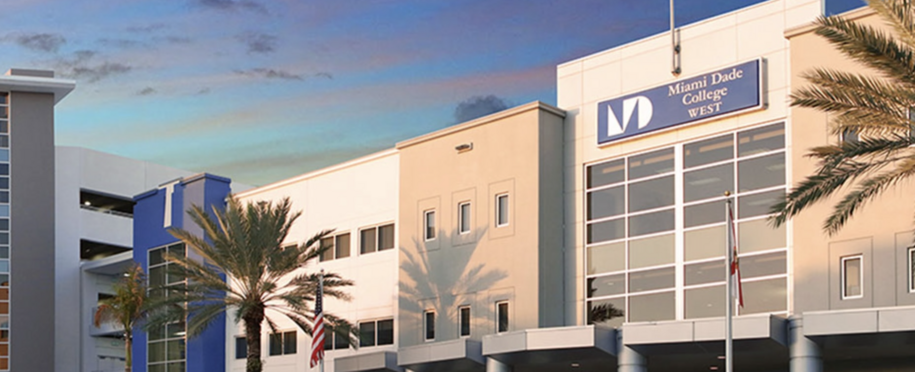
Known as Democracy’s College, Miami Dade College (MDC) is one of the nation’s largest public institutions of higher education. With more than 100,000 students enrolled, eight campuses offer 300-plus distinct degree pathways, including associate and baccalaureate degrees, career certificates, and apprenticeships.
At this open-access, low-tuition institution, most students attend part-time, and they come from diverse backgrounds. MDC’s students hail from 167 nations and speak 63 languages. They are often the first generation in their family to attend college, and for many, this is the first time they have been in college. Many have competing demands for their time, juggling classes, work, and family responsibilities.
Despite students’ busy lives, however, MDC offers them the chance to stretch and grow: “Opportunity changes everything,” says the college’s tagline.
Changemaker Education at MDC
Changemaker education is one such opportunity at MDC. The College has had a long history of investing in changemaking work. Its work in this area was recognized in 2015, when it became an Ashoka U Changemaker Campus.
Sandra Louk LaFleur has served as director of the Office of Changemaker Education since its founding in 2017, when MDC added additional structure to the work it had been doing for decades. The office comprises several institutes: the Institute for Civic Engagement and Democracy (iCED); the Earth Ethics Institute (EEI); the Jaffer Institute for Interfaith Dialogue and Education; and a new social innovation arm.
Initially, changemaker education consisted of a calendar of events—volunteer activities that students could choose. But LaFleur says, “We wanted to adopt a way of educating students that would be more transformative. Coursework and co-curricular experiences would be infused with a call to action.”
The goal is for students to see themselves as “positive change agents in their communities, in their homes, in their workplaces.”
“Changemakers aren’t just born. They can be developed,” LaFleur notes. “Changemaker education is proving to be really important to our student experience and to our faculty.”
MDC’s emphasis on changemaker education is intended to counteract the civic empowerment gap which, as Meira Lewis explains in No Citizen Left Behind (2012), represents the differential access to opportunities that build civic knowledge and skills. This gap is often a reality for many students coming from underserved communities.
As Joshua Young, director of iCED, says, “Students who are low-income, minority, or first time in college can face a lot of barriers as far as having these opportunities to engage in civic learning experiences. That has repercussions on our community, our state, and our world because they are less likely to go on and be engaged community members and citizens.”
EP’s Work with MDC
After encountering Essential Partners at a national conference, LaFleur was struck by the concept of dialogic pedagogy and its implications for changemaking. She used a mini-grant from Ashoka U to bring EP to MDC. To date, EP has visited MDC virtually or in person several times.
The first included a day for about 20 faculty to learn about dialogic classroom practices and then a day for iCED and EEI staff. The second took place during the pandemic: 20 faculty attended an extensive two-day professional development experience. In both cases, faculty were very receptive to and positive about the training they received in how to build dialogic structures to enhance student learning.
The Office of Changemaker Education then decided to expand the focus of its work with EP to include co-curricular touch points with Student Life and student leaders. In summer 2025, EP offered “Depolarization Skills,” a three-part micro-training series focused on facilitation, communication, connection, and holding dialogue in any kind of space—one-on-one conversations, a staff or student club meeting, a small group in a classroom, or a retreat. This training brought together about 30 faculty, staff, and students from several MDC campuses.
The inclusion of Student Life directors as well as two students was a huge win, as it represents the chance to further build dialogic spaces outside of the classroom. Naya Escandon, Student Government Association president for one of MDC’s largest campuses, Kendall Campus, saw the potential for sharing this training with other student leaders.
Laura Garcia, a student civic ambassador for iCED, also found the training to be very powerful. “I stepped out of that training feeling confident and feeling empowered to tackle difficult situations,” she says, “whether it be facilitating, my own personal conversations with people I love, or at work.”
EP was at MDC again in fall 2025 for Changemaker Week – an annual event where changemaking activities and education are elevated across the entire college. During that week, faculty had the opportunity to attend a three-hour EP workshop on holding dialogue in the classroom. At the end of 2025, EP will return once more to MDC to hold another two-day faculty training on the dialogic classroom.
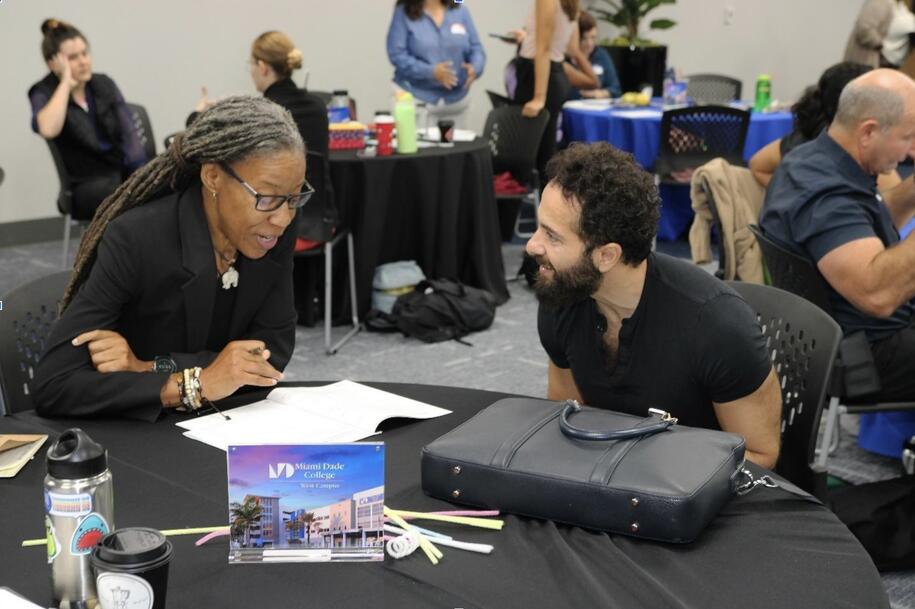
“It helps me be a more authentic leader. I’m able to role model for a lot of my staff what it looks like for them when they have to do the same in difficult moments or difficult conversations with others.”
Sandra Louk LaFleur
Director of the Office of Changemaker Education
Dialogic Micro-Practices
Many of those who attended the summer 2025 Depolarization Skills training began applying EP dialogic micro-practices immediately.
For LaFleur, thinking about practices that make for more inclusive spaces, the training helped her learn “how to manage, how to lead, and how to hold space with my team, to honor the sacredness of the container.” She reflects, “It helps me be a more authentic leader. I’m able to role model for a lot of my staff what it looks like for them when they have to do the same in difficult moments or difficult conversations with others.”
Both Young and Jordan Chang, Student Life director at the Hialeah campus, are using tools like creating agreements when they facilitate staff meetings. Chang says, “Prior to jumping into an agenda, I might do a check-in with the team. What is a highlight this week that stood out for you personally? What is something you’re looking forward to, and how can we hold you accountable on that? I want to have those moments for understanding and agreement before we jump into the meat and potatoes of a meeting agenda.”
Chang also likes the idea of “recentering,” which he picked up from the EP training. “The meeting gets lively,” he says, “and internally I’m thinking ‘how nice would it be to recenter?’ We put a pin in it, stop the meeting, and go for a 10-minute walk.”
Young, Chang, and Garcia were all struck by EP’s teaching about the “ladder of inference.” Garcia uses this micro-practice at her workplace and with her family and friends.
“I am actively trying to become mindful of my thought process when I am having difficult interactions with people,” she says. “I actively let them speak, try to listen to what they are saying. Problem solving becomes very easy when you’re just working with what you have instead of being at the top of your ladder and making your own conclusions.”
Garcia finds that she is carrying other skills forward from the training as well. “Essential Partners brought me closer to what I want to be when it comes to speaking, and they brought me closer to what I want to be when it comes to the conversations I want to have,” she says. “When I graduate, I’m going to go into the workforce, and the learning from these sessions is going to come through. It’s good to have one more tool in your toolbox.”
The Future of Changemaking Dialogue
“Changemaker education has continued to seep into the groundwater here. It’s becoming more of a topic of interest in terms of our national context and the notion of civility and dialogue,” says LaFleur. “If we cannot get this nailed down, the rest doesn’t matter. We can’t engage in changemaking if we don't know about one another because we don’t know how to hold space that’s uncomfortable. To say yes to changemaker education is to say yes to dialogue.”
Young, too, sees the transformative power of dialogue at MDC. “I am very concerned about how divided we are as a country and how polarized we are, how there's just a growing lack of civility, and we all live in our bubbles. It’s just getting worse and worse,” he says.
“With our role as educators and the work that we’re trying to do through changemaking, we can help students build the right skills needed to effectively navigate sharing difficult conversations across differences,” he concludes. “There’s nothing more important than that for your career, for your personal life, for your professional life, for the health of our democracy.”
Related Impact Stories







Testimonials

Jamie Kleinman, Associate Professor“I want every STEM class to have a dialogue. Imagine if the students had more practice doing this in more of their classes. It really speaks to the nature of approaching this from a systems perspective and how big a need there is for that.”
Department of Psychological Science, University of Connecticut
-
Undergraduate StudentI started to trust everyone in the class—I felt heard and I felt that people wanted to listen. As a result, I wasn’t afraid to let my past come out and let people learn from what I have been through.
Bridgewater College, Virginia
-
Karen Ramirez, Director of the CU Engage ProgramWe get more requests [for campus dialogue] than we could ever respond to.… I’m proud that our work on campus is actually kind of unusual, because it doesn’t support just one population. It supports everyone—students, staff, faculty, graduate students. I don’t know if there are other University of Colorado projects going on that hit all of our campus population.
University of Colorado, Boulder
-
Undergraduate StudentEvery opinion was accepted. No one felt judged or uncomfortable talking to one another. These have been, by far, the best classroom discussions I have ever had.
Bridgewater College, Virginia
-
Undergraduate StudentIt’s nice to talk about things that we encounter all the time but rarely get talked about. This made me hopeful that there are people who are willing to talk about serious issues.
Dartmouth College, New Hampshire
-
Undergraduate StudentAt the beginning of the semester, there was not much participation in class. But by the end, almost everyone had something constructive to add every day.
Bridgewater College, Virginia
-
Undergraduate StudentWe tackled really difficult topics and this helped everyone know each other and understand each person's individual perspective. Over the course of the semester, I became much more comfortable engaging with my classmates—specifically because of the peer dialogue groups.
Bridgewater College, Virginia
-
Undergraduate StudentDuring one dialogue, as we were reading The Joy Luck Club, we were asked to discuss our relationship to America. There were students who grew up in the United States and also those who hadn’t—and I was surprised to hear that everyone had equally complex relationships with the topic.
I appreciated being able to hear and express the full depth of our own context before delving into a discussion about first-generation immigrants.
Gordon College, Massachusetts
-
Program ParticipantThis is the best adult learning experience I have had in the past five years. I wanted to learn new skills—I did!
-
Program ParticipantI felt an amazing sense of accomplishment when the Essential Partners training ended; that I'd done something important for my community and something important for me.
Massachusetts
-
Janet Bixby, Director of Community Dialogues“Essential Partners has the magic sauce—its trainings. Working with Essential Partners and Community Dialogues has enabled us to say, ‘Hey, we have tools to help us be able to do this, and we have ways to do this. We can address these things.’ That's been incredibly useful and powerful.”
Lewis & Clark
-
Teresa Grettano, Associate Professor and Director of the First-Year Writing programFacilitated dialogue creates a classroom atmosphere in which exploring uncomfortable issues and asking difficult questions is an expected part of the process, and it allows students space to engage each other without fear of the vitriol common in our public discourse.
University of Scranton (PA)
-
Ben Meoz, VP for Student Life and Dean of Students“We want to cultivate genuine curiosity among students so that they really open themselves to the needs of others and also feel like others have an awareness of what their needs and experiences are.”
Lewis & Clark
-
Undergraduate StudentI have learned how to not be offended and to be better prepared to receive other people's communication. You don't have to agree, but you can respect the other person.
Randolph College (VA)
-
Nicki Glasser, Policy CoordinatorWhat surprised me was how much you could transform a relationship during a three-hour conversation.
Transformation Center, Massachusetts
-
Bob Bordone, Expert and AuthorEssential Partners does the best work in the field of dialogue and communication.
Harvard Negotiation & Mediation Clinical Program, Co-Founder
-
Cricket Fuller, The Christian Science MonitorThis wasn’t a policy debate [about guns]. Instead, two people whose backgrounds and views diverged in almost every way possible shared a moment of honesty that struck at the heart of the matter.
Boston, Massachusetts
-
Janet Lansberry, Weissman Center Assistant DirectorThis was probably the most profound workshop that we ever brought to campus. It offered a really unique foundation in personal insight.
Mount Holyoke College, MA
-
Megan DeFranzaHere safe space was created for pastors and church leaders to wrestle with topics like evolution which are all too often “off limits” or believed to be antagonistic to the faith.
Gordon College, Massachusetts
-
Katie Shear, Civic Engagement CoordinatorUsing what we learned from Essential Partners, staff were able to model effective and respectful communication for students. A next step would be for us to help students employ some of these methods themselves. The staff not only gained skills in communication but also left feeling supported by each other in the work that we do.
Southern Vermont College, VT
-
James Rucker, Faculty MemberIt is really different than it was before. The Essential Partners process has given me the power to be heard and be seen. It’s unreal.
Randolph College (VA)
-
Jonathan Noyalas, Director of the McCormick Civil War Institute“RSD has been the most transformative thing in my 21 years of teaching. … Students have a greater desire to open up in class about things because they know that a Noyalas class is a safe environment. ‘I can say things here. I’m not going to be judged. I understand I’m contributing to a broader conversation.’”
Shenandoah University
-
Beth MendozaDialogue gets more results. It makes decision-making easier. It makes creating participation easier … our greatest organizational impact has been more contributions as well as more effective and efficient meetings.
Moraine Park Technical College, Wisconsin
Dr. Jill DeTemple, Religious Studies FacultyAfter using this approach in my classroom, I am now more willing, and more able, to engage students in meaningful conversations about potentially contentious issues. Whereas I used to nod toward things like homosexuality in religious life, interfaith marriage, or the role of government in reproduction, now I build these conversations into the class so students can learn to speak about their experiences, and so they learn to listen and learn from those with whom they might disagree.
Southern Methodist University, Texas
-
Noga Shemer, Associate Professor in Anthropology“When I started bringing the RSD model into the classroom, it changed everything, and I had this overwhelming sense of what the classroom could be. The student feedback was unlike anything I had seen before. Students said, ‘Wow, why haven’t we had the chance to do this before? And why don’t we get to do this more often in our education?’”
University of Connecticut
-
Noga Shemer, Associate Professor in Anthropology“Students come to university so they can think deeply about issues that matter. They are the future, and the stakes are high. They want spaces where they can think these things through.”
University of Connecticut
-
Anne Hopkins Gross, Dean of StudentsThe Essential Partners workshop was a way of building up our ability to talk about more difficult issues, such as poverty and GLBTQ safe spaces. It was really the foundational entrée into those more challenging issues of race, ethnicity, sexuality, and gender. People walked away feeling much more confident about having difficult conversations.
Southern Vermont College, VT
-
Undergraduate StudentThe professor was able to engage every student. She encouraged them to present new ideas. Dialogue helped create an environment that really deepened the understanding of the material.
Southern Methodist University, Texas
-
Undergraduate StudentI feel more comfortable participating in class and less defensive when other students disagree. And because I learned more from my fellow students about their views, I now feel less competitive with them than in other classes.
Bridgewater College, Virginia
-
Patrick Hale, director of Multicultural and Identity ProgramsOne of the things that’s so crucial to even fostering dialogue around diversity, equity, and inclusion is creating opportunities for folks to engage in deep reflective self-awareness.
Babson College, MA
-
Undergraduate StudentI learned to expect the best of my classmates, even when we don’t agree. I can’t write off their opinions anymore, despite our disagreements.
Bridgewater College, Virginia
-
Undergraduate StudentThe most significant thing for me was learning how to ask for more information rather than trying to persuade a person to think differently. I also learned helpful dialogue tips, which are more effective during difficult conversations. If I encounter a difficult dialogue with any of my residents, I plan on using the techniques I learned in this workshop to facilitate those talks.
Northeastern University, MA
-
Etionette Nshirmirimana, Burundian Master TrainerI realized that by using the “dialogue” approach, people could talk of what is deep in their heart, especially things that have harmed them.
Burundi
-
Anjali Bal, Associate Professor of MarketingWe talked about where we are in the world right now, so we talked quite a bit about polarization. Essential Partners showed how these conversations are becoming more taxing and challenging because of that polarization. These were some first steps in terms of how we can start to have those conversations.
Babson College, MA
-
Undergraduate StudentI learned a lot about myself from others’ perspectives—it was comforting to hear similar values and ideas expressed, yet really eye-opening and intriguing to hear very different philosophies.
Dartmouth College, New Hampshire
-
Anjali Bal, Associate Professor of MarketingOne of the things that we talked about was the ability to hear another person’s point of view, even if our minds aren’t changed. We have to remember that any sort of movement is movement. If we don’t acknowledge small movement, then we just stay on two different sides, and it’s all black and white, and we don’t hear each other.
Babson College, MA
-
Elizabeth Zehl, Undergraduate StudentEssential Partners' process gives people the space to be intellectually curious and to engage with others on important issues in a way that also benefits their own understanding of what they believe.
Randolph College (VA)
-
Lucinda Garcia, Researcher, Educator & AdvocateThe Dialogic Pedagogy Fellowship at Tufts University, in collaboration with Essential Partners, gave me transformative social-emotional learning and facilitation skills to support meaningful dialogue in the classroom. I’m excited to apply what I’ve learned to design questions that invite personal narratives, value-based discussion, and comfort with complexity—all in service of building a classroom climate where productive dialogue and engaged learning can flourish.
-
Kim Davidson, OmbudsI’ve gained not only confidence but tools. The Essential Partners training was worth every penny.
Oberlin College, Ohio
-
Undergraduate StudentDialogue challenged us to think more deeply about the class topics. Talking about our own thoughts and experiences in relation to the topic also challenged us to think about our own views and articulate them more clearly.
Gordon College, Massachusetts
-
Amy Cottrill, Birmingham-Southern CollegeThe past few years in our country have been the most divisive and alienating in my lifetime, which can be a tremendous challenge in the classroom that aims for community, shared experience, and listening with empathy to opinions that are different from one's own. The Essential Partners workshop I attended provided invaluable tools to meet the challenges of teaching today. It helped me reimagine the classroom as a place to help students learn the essential tools of living and learning in community and interconnection, skills that are necessary in every single area of life. I have no doubt that my teaching has been dramatically reshaped in light of my introduction to structured dialogue and I feel like I have so much more to offer my students because of that.
Birmingham, AL
-
Undergraduate StudentI notice that my classmates take much more care when speaking about people who practice other religions. They make fewer assumptions, and they’re more careful with their words to make sure to avoid unintentional connotations.
Bridgewater College, Virginia
-
Alex Lyford, Assistant Professor of StatisticsI can't possibly overstate the positive effects the Dialogic Classroom training had on the curriculum and approach to my Introduction to Data Science class. The difference in the course from a year ago and now is night and day. My lectures are now filled with meaningful discussion and discourse—often related to sensitive topics that I wouldn't have dared touching without the training. Student feedback about these discussions has been overwhelmingly positive, and there is no chance that I would have had the wherewithal or initiative to revamp the course in such a dramatic manner without the training.
Middlebury College
-
Program ParticipantI did not anticipate having as many concrete takeaways as I do. I feel there is an immense practical application.
-
Dr. Brooke Vuckovic, Clinical Professor of Leadership“The Dialogic Classroom is by far and away the most skillful and thoughtful professional development I have had in years as an educator.”
Kellogg School of Management
Lauren Barthold, Philosophy FacultyI’ve learned that it is not enough to announce my commitment to dialogue and expect students to know what I mean; I need concrete exercises to allow students to learn how to do it.
Endicott College, Massachusetts
-
Megan DeFranzaThere is a need not only for safe space within our churches but for our church leaders who often feel alone, or who may feel their job could be at risk if they engage in controversial conversations. How are they to make safe spaces in their own congregations for healthy dialogue if they rarely experience safe space to do the same?
Gordon College, Massachusetts
-
Undergraduate StudentAs a pharmacy major, I do not receive much training on how to handle difficult or controversial conversations. I think that this training will help me not only in my duties as a resident assistant, but in discussing medications and therapies with future patients when the conversation becomes difficult.
Northeastern University, MA