

Impact Snapshot: Students Use RSD to Revive a Black Student Union
At the Hawken School, a co-educational private day school with more than 1,500 students, students proved that dialogue can be an effective tool for bridging divides and rekindling community.
During the fall semester of 2025, Hawken’s Black Student Union (BSU) disbanded. There were several reasons, from the limited capacity of its senior leadership to the disconnect between the organization’s vision and the actual needs of the student body, leading to a lack of participation.
However, Mae Yanamayu and several other dedicated students applied the practices and principles of EP’s Reflective Structured Dialogue (RSD) to revive the organization.
Can we talk? (But for Real Though)
“In my intensive with Mr. Epps titled, ‘Can we talk? But for Real Though,’ we learned all about dialogue,” said Mae. “We went to Cary Academy in North Carolina to observe how the school uses dialogue … and I think that kind of really inspired me. Coming back into the second semester, we started having discussions and realized that we wanted to make a BSU that served the community.”
Equipped with RSD, the student leaders hosted a discussion session, deploying dialogic principles such as questions of understanding. “In the intensive we learned about questions of understanding, basically asking [questions] not to persuade someone's opinion but learn a little bit more about what they believe in and their values. We wanted to center our discussion around that. So after a couple of meetings, we decided to host a very private discussion with our Black members,” Mae explained.
The meeting was a success. A large number of students turned out, prepared to be vulnerable with each other about their disappointments, hopes, and expectations for the BSU’s future. In the end, the general sentiment boiled down to a need for trust.
“We were talking and realized they didn’t feel we had much follow-through,” said Mae. “They were saying, ‘We don't trust you. If you say you’re going to do something, are you actually going to do it?’ We realized we needed to address that. After that meeting, we hosted our first BSU session since it had disbanded in the fall.”
Although Mae felt anxious going into this process, worried that students wouldn’t be willing to engage, her personal encounter with a Black freshman who was seeking a safe space on campus solidified her commitment and showed her that BSU was needed more than ever.
“They were insightful, passionate, and eager to develop their facilitation skills. I especially appreciated how they incorporated the learning into spaces beyond the classroom—even approaching a newer faculty member to encourage the use of dialogic practices in their teaching.”
Darnell Epps, Director of Fair Play
Hawken School
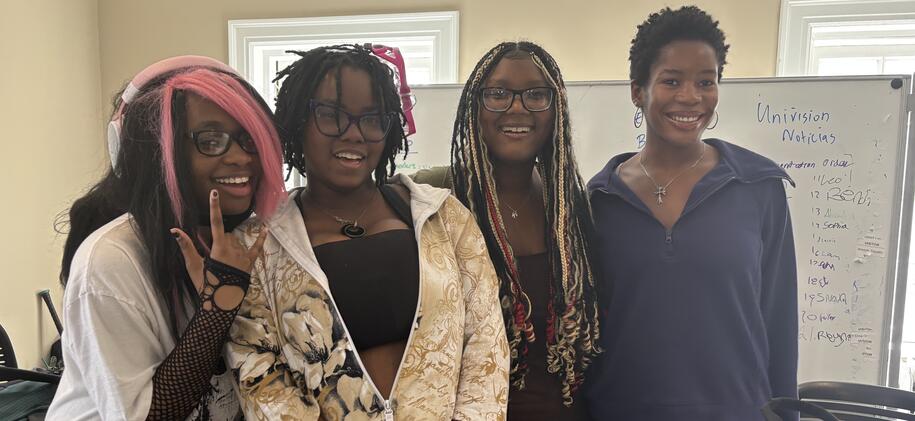
Mae Yanamayu (R) with other leaders of the Black Student Union
Brilliant Leaders
Mae’s commitment to bringing dialogue beyond the classroom did not go unnoticed by Darnell Epps, the director of Fair Play across all of Hawken's campuses.
“Mae and her MSH co-leaders quickly stood out as exemplary participants in my dialogue-intensive course,” said Epps. “They were insightful, passionate, and eager to develop their facilitation skills. I especially appreciated how they incorporated the learning into spaces beyond the classroom—even approaching a newer faculty member to encourage the use of dialogic practices in their teaching. I am excited to see how Mae and her co-leaders will continue to deepen dialogue work, not only within BSU but across the entire campus. They are brilliant leaders!”
And that first official BSU meeting following the restructuring? It was a success too, featuring games and trivia to foster connection. Attendees were surprised that the meeting delivered on the promises made previously by the leadership team.
Mae didn’t just use her dialogue skills to revive a community at Hawken School. Her experience with RSD has also had a profound impact on her as a person.
“I think in my personal life I’ve just learned to communicate more,” said Mae. “I feel more comfortable addressing things …I think [this experience] is definitely going to stay with me in a lot of ways,” she shared.
Mae aspires to major in psychology and pursue a career in marriage and family therapy—and she plans to keep these dialogic principles in her repertoire.
So what’s next?
For Darnell Epps, working with Essential Partners has given him the tools to empower students and educators alike as part of a broader effort to cultivate dialogue throughout Hawken’s community.
“Overall, working with EP has been a transformative experience and has provided me with a framework for introducing our community to dialogic concepts and practices,” said Epps. “It has given me the language to clearly describe communication cycles and to structure dialogic spaces more intentionally, fostering a different kind of conversation. This was something our community was seeking but needed support in developing. EP has provided that support many times over. I look forward to partnering with student leaders and classroom teachers to expand the dialogue program in the coming year and beyond.”
So what’s next for Hawken School’s Black Student Union?
For starters, the group is integrating junior leaders into the organizational structure as a tactic to prevent future leadership complications. They’re also hoping to make RSD a concrete part of the organization’s programming, showing how powerful dialogue can be in building community, repairing trust, and fostering spaces where every voice can be heard.